 Piotrek Co., Ltd. |
|
Conductive (ion-conductive) binder for positive and negative electrodes PIOXCEL Launch of highly conductive products x10^-4 S/cm performance New Highly conductive binder Solution Conductivity (Reference Value) For the Cathode electrode High-conductivity Grade CBC-54N20S 20%Concentration NMP solution Ⅹ10^-5 S/cm Ultra-High Conductivity Grade CBC-54N20H 20%Concentration NMP solution X 10^-4 S/cm For the Anode electrode High-conductivity Grade CBA-92N20S 20%Concentration NMP solution Ⅹ10^-5 S/cm Ultra-High Conductivity Grade CBA-92N20H 20%Concentration NMP solution Ⅹ10^-4 S/cm The solvent used can be changed to acetonitrile or DMSO. Features The highly conductive binder is a functional binder designed to improve grain boundary resistance. For example, a coating is formed at the interface of a high-nickel active material (such as NCM811) to suppress oxidative degradation of the active material. In addition to measuring, it also has the effect of reducing the particle interface resistance. Furthermore, the particle interface resistance of the negative electrode interface It also plays a role in suppressing interfacial resistance between particles through improvements and the incorporation of solid electrolytes. |
|||||||||
| CB Series - Overview | |||||||||
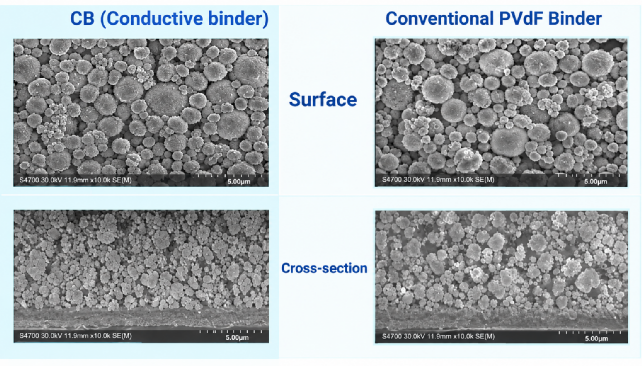
| A conductive (ion-conducting) binder is produced using a material in which an ionic liquid has been addition-polymerized to PVdF. This conductive binder is mixed with the active material while retaining both ionic and electronic conductivity, forming an ideally dense packing. We can manufacture electrodes with a porous structure. We offer options using either ion-conductive binders or electrically conductive binders. Since this ion-conductive binder formulation enables the fabrication of electrodes with a "closest-packed void (pores and porous structure)," it is suitable for high-voltage applications. Regarding the application of ionic liquid-based electrolytes, an optimal conductive network structure is formed within the electrode in terms of impregnation and retention properties. It possesses certain characteristics. |
 |
||||||||
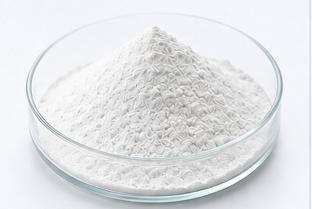
| PIOXCEL CBC5030FP Highly dispersible powder product | |||||||||
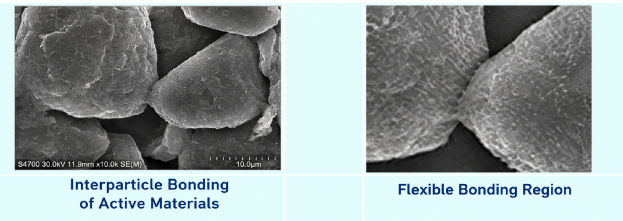
| Bonding structural property data | |||||||||
 |
|||||||||
| Fabrication of electrodes with a close-packed void (pore and porous) structure (SEM image) | |||||||||
 |
|||||||||
We sell electrodes formulated with various ion-conductive binders. |
|||||||||
An ideal void structure formed by the arrangement of secondary particles within the voids created by the bonding of primary particles an electrode structure is formed that possesses this. This electrode is formed by filling this void with an ionic electromer. Therefore, by coating the interface of the active material particles and the solid electrolyte particles incorporated in the formulation, the interfacial resistance is significantly reduced it has become possible to suppress it to |
|||||||||
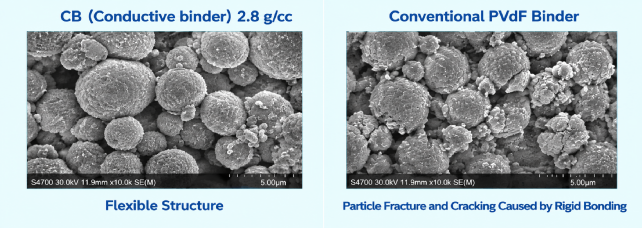
| Flexibility of Conductive Binder (Press Density) | |||||||||
 |
|||||||||
| The bonding areas between particles possess flexible properties, allowing for the incorporation of graphite and silicon (SiO) materials. This makes it possible to internally absorb the expansion and contraction of the negative electrode at a constant rate. Furthermore, the press density can be adjusted using a general-purpose binder. Compared to PVdF-based and SBR-CMC-based materials, it is possible to increase electrode density by more than 20%, leading to an improvement in volumetric energy density.。 |
|||||||||
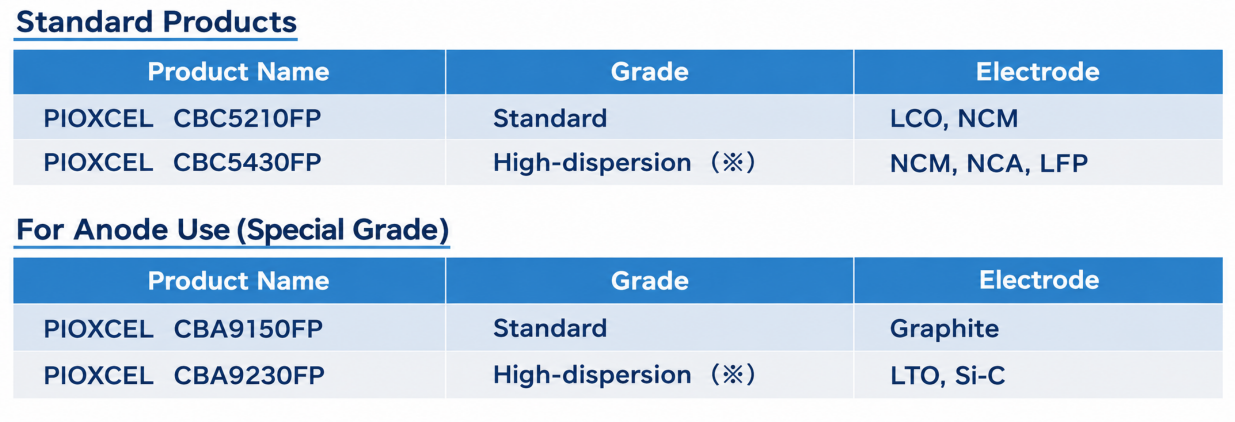
| Part Number List | |||||||||
 |
|||||||||
| (*) This is a suitable grade that enables close packing, thereby enhancing the dispersion effect of the conductive material. | |||||||||
| Please contact us separately regarding requirements such as conductive polymer matrices or ion-conductive binders for solid electrolyte applications. We can supply this as a highly conductive binder (solvent-based solution). |
|||||||||
| Characteristics of Ion-Conductive Binders | |||||||||
| 1. The CB binder forms a close-packed structure, significantly improving IR drop. | |||||||||
| 2. In electrode formulations, the CB binder delivers optimal performance?surpassing general-purpose PVdF binders at usage levels ranging from an equal amount to 30% less than that of the conductive material. |
|||||||||
| 3. Demonstrates a significant advantage in low-temperature performance compared to general-purpose PVdF binders. 4. Significantly improved interfacial resistance between solid electrolyte particles. |
|||||||||
|
||||||||||||