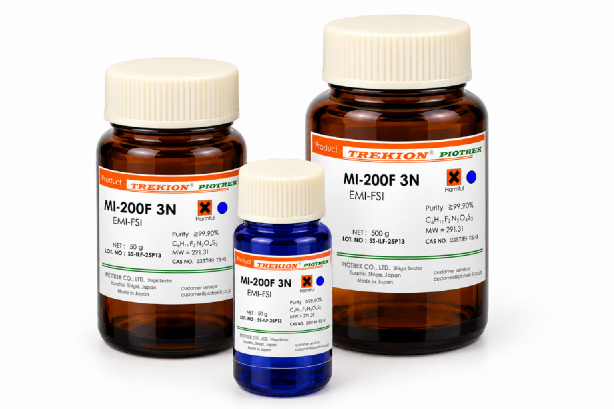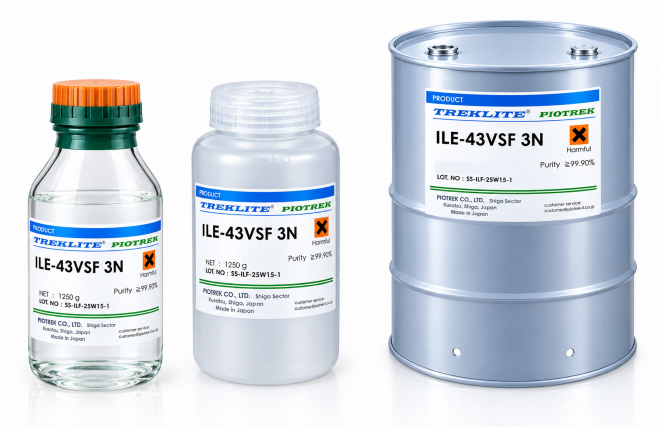
| ◆Ionic liquid Ionic liquids such as 1-methyl-3-ethylimidazolium BF4 were first introduced by J.S. Wilkes and M.J. Zaworotko in *Chem. Commun.* (1992, p. 965) ・It is a salt in a liquid state composed solely of ions that has a melting point near room temperature (room-temperature molten salt). |
|||||||||||||||
| ◆Functional characteristics of ionic liquids (1) Solvent consisting solely of ions (2) Transparent to pale yellow liquid (3) Non-volatile (4) Non-flammable (5) Completely solvent-free system (6) Chemically stable (7) High decomposition voltage (difficult to electrolyze) (8) Good thermal stability; heat resistance >300 ℃ (9) High ionic conductivity: 10^3 S/cm (10) High potential window: -0.5 to 6.0 V (Varies depending on grade) |
◆Applications of ionic liquids ・Electrolytes for electrochemical devices ・Applications in secondary batteries ・Applications as capacitor electrolytes ・Raw materials for proton-conducting membranes in fuel cells ・Electrolytes for solar cells ・General industrial applications ・Non-aqueous solvents ・Novel reaction solvents ・Applications in biochemistry and bioreactions ・Heat transfer media |
||||||||||||||
|
|||||||||||||||
|
|||||||||||||||
|